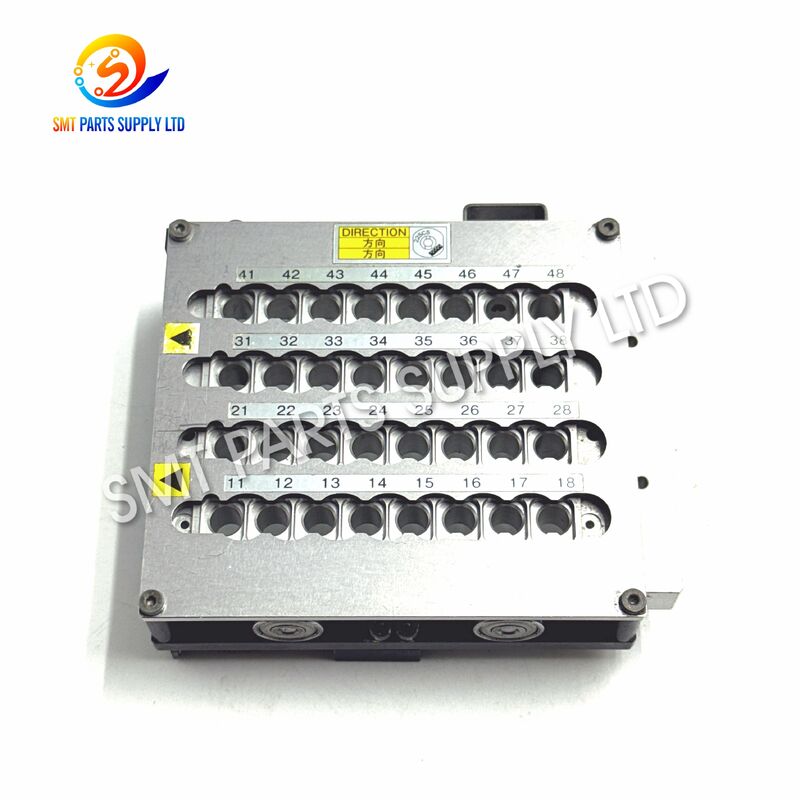
| Brand Name: | Panasonic |
| Model Number: | N610087794AA N610074584AA |
The Panasonic N610087794AA / N610074584AA Nozzle Changer is a dedicated SMT machine component designed for use with compatible 16-nozzle head configurations in NPM pick and place equipment. Installed within the machine's nozzle management area, the unit provides defined storage positions where placement nozzles can be held and accessed during automated production. This allows the placement head to change nozzle types according to component requirements without relying on repeated manual nozzle replacement.
For SMT factories operating mixed PCB assemblies, a properly functioning nozzle changer is important for maintaining consistent equipment operation. Wear, contamination, mechanical damage, incorrect nozzle positioning, or deterioration of the changer assembly can interfere with automatic nozzle exchange. Replacing a damaged unit with the correct part-number configuration can help restore reliable nozzle management and reduce unnecessary production interruptions.
The N610087794AA and N610074584AA references should always be checked against the machine configuration, head type, existing installed unit, and equipment documentation before ordering.
| Item | Description |
|---|---|
| Brand | Panasonic |
| Part Number | N610087794AA / N610074584AA |
| Product Type | SMT Nozzle Changer |
| Head Configuration | 16-Nozzle Head |
| Application | SMT Pick and Place Machine |
| Compatible Series | NPM Series |
| Primary Function | Automatic Nozzle Storage and Changing |
| Installation Area | Nozzle Change / Nozzle Storage Position |
| Industry | Electronics Manufacturing / SMT Assembly |
| Supply Type | SMT Machine Spare Part |
| Order Verification | Part Number and Machine Configuration Required |
Modern pick and place machines process many different electronic components within the same production program. Different packages may require different nozzle dimensions, tip geometries, vacuum characteristics, or handling methods.
The placement head therefore cannot always use one nozzle type throughout an entire PCB assembly program.
A nozzle changer provides organized storage positions that allow the machine to exchange nozzles according to programmed production requirements.
Typical component groups that may require different nozzle selections include:
| Component Group | Nozzle Selection Requirement |
| Small passive components | Small-tip nozzle configuration |
| IC packages | Appropriate vacuum contact area |
| LEDs | Package-sensitive nozzle selection |
| SMD connectors | Shape and size dependent |
| Larger components | Larger pickup surface |
| Mixed PCB assemblies | Multiple nozzle types within one program |
The changer itself does not perform component placement. Instead, it forms part of the nozzle management process supporting the placement head.
The nozzle changer operates repeatedly during normal SMT production. Depending on product mix and machine programming, nozzle changes may occur many times during production shifts.
Long-term operation can create several maintenance issues.
Repeated nozzle loading and unloading may gradually wear locating surfaces, holders, guides, or other mechanical interfaces.
If the nozzle is no longer positioned correctly in its storage location, the head may experience difficulty during pickup or return operations.
Dust, solder paste residue, flux particles, adhesive residue, and general factory contamination may accumulate around the nozzle changer.
Contamination can affect nozzle seating and can interfere with smooth nozzle exchange.
A nozzle that is not seated correctly may create an unstable pickup position.
Typical causes include:
A collision, incorrect maintenance operation, misplaced nozzle, or abnormal machine movement may damage part of the changer assembly.
Even relatively small deformation can become important because nozzle exchange depends on repeatable mechanical positioning.
Machines operating for long periods may require replacement of nozzle-management components during preventive maintenance or refurbishment.
Keeping a suitable spare nozzle changer available can shorten recovery time when an installed unit becomes unusable.
| Production Symptom | Possible Inspection Direction |
| Nozzle change failure | Check changer condition and nozzle seating |
| Nozzle cannot be returned | Inspect storage position and alignment |
| Head cannot pick nozzle | Check nozzle position and changer interface |
| Frequent nozzle exchange alarms | Inspect contamination and mechanical wear |
| Nozzle falls or sits loosely | Check holder or locating condition |
| Repeated manual intervention | Evaluate changer operation and installation |
| Production interruptions | Check changer together with head and nozzle condition |
These symptoms do not automatically mean the nozzle changer is defective. Machine alarms can also be related to nozzles, sensors, placement heads, pneumatic systems, software settings, calibration, or other mechanical components.
Correct troubleshooting should therefore be performed before replacement.
When inspection confirms that the existing nozzle changer is damaged, worn, contaminated beyond practical recovery, or mechanically unsuitable, replacement with a correctly matched unit can restore the nozzle storage and exchange function.
The recommended purchasing procedure is simple:
Check the label, machine parts list, maintenance record, or currently installed unit.
Reference numbers supplied for this product are:
Because machine revisions can differ, do not select the part only from the machine family name.
Verify that the equipment uses the relevant 16-nozzle head configuration.
Nozzle changers for different head structures should not automatically be treated as interchangeable.
Photos are especially useful when the machine has been upgraded, rebuilt, or previously repaired.
Recommended photos include:
Before ordering, compare the requested reference with the available stock configuration.
This reduces incorrect purchasing and unnecessary machine downtime.
| Specification | Details |
| Product Name | Nozzle Changer |
| Part Numbers | N610087794AA / N610074584AA |
| Head Type | 16-Nozzle Head |
| Equipment Category | SMT Pick and Place Machine |
| Application Series | NPM |
| Functional Category | Nozzle Management System |
| Function | Stores and supports automatic exchange of placement nozzles |
| Installation Purpose | Maintenance or replacement |
| Placement Process | Surface Mount Technology |
| Verification Method | Part number, head type and machine configuration |
| Packaging | Protective industrial packing |
| Quantity | Available according to quotation |
| Condition | Confirm according to quotation |
| Technical Inspection | Available configuration checked before dispatch |
| Dimensions | Confirm before order if required |
| Weight | Confirm before order if required |
Important: Exact dimensions, weight, material composition, revision interchangeability, and machine-specific configuration should be confirmed from the actual supplied unit before being entered into a purchasing specification.
| Reference | Product Description | Head Reference | Application |
| N610087794AA | Nozzle Changer | 16-Nozzle Head | Compatible NPM configuration |
| N610074584AA | Nozzle Changer | 16-Nozzle Head | Compatible NPM configuration |
These two numbers may appear in sourcing records, machine configurations, or replacement references. Their exact interchangeability should be confirmed according to the installed machine rather than assumed solely from similar product descriptions.
The N610087794AA / N610074584AA Nozzle Changer is mainly used in SMT production equipment where automated nozzle management is required.
Typical applications include:
Maintenance teams may replace the nozzle changer when the original installed unit shows wear, damage, contamination, or irregular nozzle positioning.
Machine repair departments may use the unit when troubleshooting automatic nozzle change errors.
Used production equipment undergoing refurbishment may require inspection and replacement of nozzle storage components before returning to service.
Factories operating several compatible machines may keep nozzle changer assemblies as critical maintenance stock.
This is useful because waiting for a replacement component after equipment failure can increase downtime.
SMT equipment service companies may replace missing or damaged nozzle changer components before delivering refurbished machinery.
| Industry | Typical SMT Application |
| Consumer Electronics | PCB assembly |
| Automotive Electronics | Control modules and electronic boards |
| Industrial Electronics | Controllers and automation assemblies |
| Communication Equipment | Network and communication PCBs |
| LED Manufacturing | LED PCB assembly |
| Power Electronics | Power control boards |
| Medical Electronics | Electronic control assemblies |
| Contract Manufacturing | Mixed-volume SMT production |
| EMS Manufacturing | Multi-customer PCB assembly |
| Equipment Maintenance | SMT machine repair and servicing |
The nozzle changer works together with the placement head and machine control system.
A simplified nozzle exchange sequence is as follows.
The machine production program associates different component types with suitable placement nozzles.
When the next component requires another nozzle configuration, the machine prepares for a nozzle exchange.
The placement head travels to the programmed nozzle change position.
Accurate changer location is important because the head must align with the required nozzle storage position.
The currently installed nozzle is placed into its designated changer position.
The nozzle must sit correctly to permit reliable storage and later reuse.
The head moves to the storage location containing the required nozzle.
The head engages the selected nozzle.
After successful pickup, the machine can continue its programmed placement process.
The newly selected nozzle is then used to pick and place the assigned components.
This automated workflow enables the equipment to process mixed component types efficiently without requiring manual nozzle replacement each time.
| Process Stage | Machine Action | Purpose |
| 1 | Identify required nozzle | Match nozzle to component |
| 2 | Move head to changer | Start automatic exchange |
| 3 | Return current nozzle | Store existing nozzle |
| 4 | Move to selected position | Locate required nozzle |
| 5 | Pick new nozzle | Prepare head for next component |
| 6 | Resume mounting | Continue PCB production |
Automatic nozzle exchange allows the machine to change between appropriate nozzles without operators manually replacing them during normal production.
PCB assemblies frequently contain numerous component package sizes. A nozzle changer enables the placement system to access different nozzle types as required.
Reliable nozzle storage and exchange help reduce interruptions related to nozzle handling.
A known spare-part reference makes it easier for maintenance teams to organize replacement inventory.
Defined storage positions help operators keep machine nozzles organized according to production requirements.
Factories can inspect the changer during scheduled maintenance and replace damaged assemblies before they create extended downtime.
Selecting the correct unit requires more than identifying the machine brand.
Use the following checklist.
| Check Item | What to Confirm | Importance |
| Part Number | N610087794AA or N610074584AA | Essential |
| Machine Series | NPM configuration | Essential |
| Placement Head | 16-nozzle head | Essential |
| Existing Unit | Appearance and mounting structure | Strongly Recommended |
| Machine Revision | Production configuration | Recommended |
| Nozzle Type | Current nozzle family | Recommended |
| Installed Label | Original identification | Recommended |
| Photos | Existing unit and machine label | Recommended |
For industrial spare parts, the part number should normally be the first purchasing reference.
Machine families can contain multiple generations and optional configurations.
Therefore, a buyer should avoid ordering simply by saying:
“NPM nozzle changer.”
A better inquiry is:
“N610087794AA nozzle changer for NPM 16-nozzle head.”
Providing the second reference, N610074584AA, where applicable can further help with confirmation.
The same NPM machine family can be configured with different placement head arrangements.
A changer designed around one head configuration should not automatically be assumed suitable for every other configuration.
Before ordering, provide:
This information improves identification accuracy.
When a machine has been operating for many years, the installed spare part may have been replaced previously.
Comparing photos can therefore be useful.
Recommended photo angles:
| Photo | Purpose |
| Front view | General configuration comparison |
| Top view | Nozzle storage layout |
| Bottom view | Mounting interface |
| Side view | Mechanical structure |
| Label close-up | Part number confirmation |
| Machine label | Equipment identification |
Not every nozzle changer issue requires replacement.
Cleaning may be appropriate if the problem is caused mainly by removable contamination and the assembly has no mechanical damage.
Replacement should be considered when there is:
The maintenance decision should be based on the actual machine condition.
Installation should be carried out by personnel familiar with SMT placement equipment.
Before servicing:
After replacement, confirm the machine's nozzle exchange operation before returning to normal production.
A functional test should check that nozzles can be stored, selected, picked, and returned consistently.
| Inspection Item | Expected Result |
| Mounting | Changer installed securely |
| Nozzle position | Nozzles seated correctly |
| Head movement | No interference |
| Nozzle pickup | Smooth and repeatable |
| Nozzle return | Correct positioning |
| Machine alarm | No abnormal changer-related alarms |
| Trial production | Normal nozzle exchange |
| Visual inspection | No collision or abnormal movement |
Proper maintenance can help extend the useful life of nozzle-management components.
Inspect the nozzle storage area for dust, debris, solder-related contamination, and foreign particles.
A damaged or contaminated nozzle may create symptoms that appear similar to changer problems.
Inspect both components.
Do not force nozzles into storage positions when they do not seat normally.
Determine the cause first.
Maintenance records can help identify recurring problems and simplify future spare-parts purchasing.
Factories with high utilization rates may benefit from keeping critical machine components available locally.
The appropriate spare quantity depends on:
For buyers sourcing SMT machine replacement parts, correct identification is often more valuable than choosing a part only from a general product name.
For N610087794AA / N610074584AA inquiries, compatibility confirmation can be performed using the information supplied by the buyer.
Recommended inquiry information:
| Required Information | Example |
| Part Number | N610087794AA |
| Alternative Reference | N610074584AA |
| Product | Nozzle Changer |
| Head Type | 16-Nozzle Head |
| Machine | NPM |
| Quantity | Required pieces |
| Condition Required | Confirm with supplier |
| Photo | Existing installed unit |
| Destination | Country or delivery location |
Providing complete information can shorten the quotation and confirmation process.
For industrial SMT spare parts, visual and configuration inspection should focus on areas related to installation and practical use.
Typical checking points may include:
Any specific testing requirement should be communicated before ordering.
The nozzle changer should be packed to protect mechanical interfaces and storage positions during transportation.
Typical packing considerations include:
For international shipments, packaging can be selected according to quantity and transportation method.
When requesting a quotation, please send:
Part Number: N610087794AA / N610074584AA
Product: 16-Nozzle Head Nozzle Changer
Machine: NPM Pick and Place Machine
Quantity: Required quantity
Condition: Required condition
Photos: Existing unit photos if available
Delivery Country: Destination country
Providing this information allows faster product checking and quotation preparation.
A: It is a nozzle changer used with compatible 16-nozzle head configurations in NPM pick and place equipment. Its primary purpose is to provide organized nozzle storage positions and support the machine's automatic nozzle exchange process during SMT component placement.
A: Do not assume interchangeability based only on a similar product description. The installed part number, placement head configuration, machine model, revision, and physical assembly should be checked before purchasing. Sending photos of the existing unit is recommended for confirmation.
A: No. This product is a nozzle changer assembly rather than an individual SMT placement nozzle. It stores and supports the exchange of nozzles used by the placement head during production.
A: Send the machine model, existing part number, head configuration, quantity, and clear photos of the installed changer. Checking these details before shipment is the most reliable way to reduce incorrect spare-part selection.
A: Replacement may be required when the unit has physical damage, deformation, worn nozzle positions, repeated exchange errors, or unreliable nozzle seating that cannot be corrected through appropriate inspection, cleaning, or maintenance.
Need an N610087794AA or N610074584AA nozzle changer for your SMT production equipment?
Send us your part number, machine model, head type, required quantity, and photos of the existing unit. We can help check the requested configuration and prepare a quotation according to your purchasing requirements.
For maintenance projects, production-line spare inventory, machine refurbishment, or urgent replacement requirements, contact us with your parts list for availability, compatibility checking, packing, and delivery information.