| Brand Name: | TAMURA |
| Model Number: | Short Resin Conveyor Finger |
| MOQ: | 1 Piece |
| Price: | Negotiable |
| Delivery Time: | 3–7 Working Days |
| Payment Terms: | T/T |
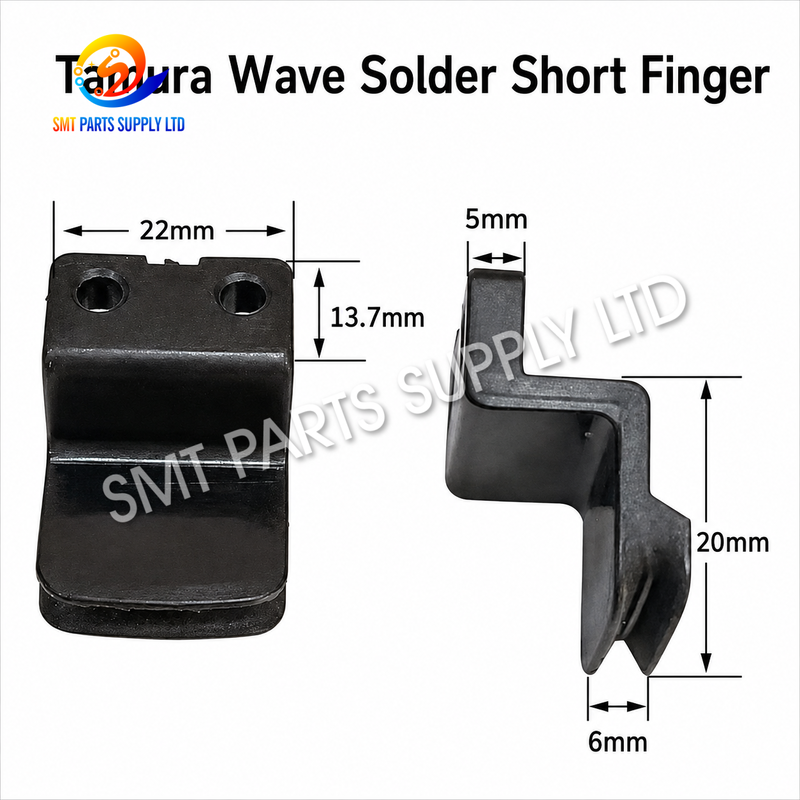
Short Resin finer for Tamura wave soldering machine
![]()
The TAMURA Short Resin Wave Solder PCB Conveyor Finger is a mechanical replacement component used in compatible Tamura wave soldering machine conveyor systems. Installed along the PCB transport chain or conveyor rail, this short-type resin finger contacts the edge of the printed circuit board and helps maintain stable board positioning throughout the wave soldering process.
PCB conveyor stability is important during flux application, preheating, solder wave contact, cooling, and unloading. Multiple conveyor fingers work together to hold and guide the PCB while allowing the underside of the board to remain accessible to the soldering process.
The Short Resin Finger is particularly suitable for replacement of damaged, worn, cracked, deformed, contaminated, or missing conveyor fingers. Maintaining all conveyor fingers at consistent positions helps reduce board shaking, uneven support, transport resistance, and accidental PCB movement.
For electronics factories using Tamura wave solder equipment, this component is a practical maintenance spare part for conveyor repair and preventive maintenance.
| Item | Details |
|---|---|
| Brand / Application | TAMURA |
| Product Name | Short Resin Conveyor Finger |
| Common Name | Wave Solder Resin Finger |
| Finger Type | Short Type |
| Material Type | Resin |
| Equipment | Wave Soldering Machine |
| Installation Area | PCB Conveyor System |
| Main Function | PCB Edge Holding and Guiding |
| Application | PCB Transportation |
| Maintenance Type | Replacement / Preventive Maintenance |
A wave solder conveyor operates repeatedly throughout daily PCB production.
Each conveyor finger directly contacts the edges of circuit boards passing through the machine. During operation, the finger is also exposed to heat, flux residue, vibration, repeated mechanical loading, and production contamination.
These conditions gradually affect the finger surface and mechanical condition.
| Cause | Possible Result |
|---|---|
| Repeated PCB contact | Contact surface wear |
| Long operating hours | Progressive mechanical aging |
| Flux contamination | Increased residue accumulation |
| Heat exposure | Gradual material deterioration |
| Mechanical collision | Cracking or deformation |
| Incorrect installation | Uneven PCB support |
| Conveyor misalignment | Excessive loading on individual fingers |
| Loose mounting | Unstable board transportation |
A single worn finger may not stop production immediately.
However, if several fingers have different heights or contact positions, the PCB may become unstable when passing through the soldering machine.
Regular inspection is therefore recommended before conveyor problems develop into production interruptions.
Replacing damaged components with the correct TAMURA Short Resin Conveyor Finger helps restore the mechanical condition of the PCB transport system.
The finger provides a controlled PCB edge contact point and works together with neighboring fingers to maintain board stability.
For factories operating continuous wave solder lines, keeping replacement fingers in spare inventory can make maintenance faster and more predictable.
| Specification | Description |
|---|---|
| Application Brand | TAMURA |
| Product Name | Short Resin Conveyor Finger |
| Product Type | Wave Solder Conveyor Spare Part |
| Finger Style | Short Type |
| Material | Resin |
| Equipment Type | Wave Soldering Machine |
| Installation Position | Conveyor Chain / Rail |
| Main Function | PCB Holding, Supporting and Guiding |
| Contact Position | PCB Edge |
| Process | Wave Soldering |
| Maintenance Use | Replacement and Repair |
| Application Industry | PCB / Electronics Manufacturing |
| Product Category | Conveyor Mechanical Component |
The TAMURA Short Resin Finger is intended for PCB transportation in compatible Tamura wave solder conveyor assemblies.
Wave soldering is widely used for through-hole component assembly and mixed-technology PCBs where boards must move continuously through several controlled process sections.
| Application | Purpose |
|---|---|
| Tamura Wave Solder Machine | PCB transportation |
| Conveyor Maintenance | Replace damaged resin fingers |
| PCB Assembly Line | Support stable board travel |
| Preventive Maintenance | Replace aged conveyor components |
| Equipment Refurbishment | Restore conveyor condition |
| Factory Spare Inventory | Prepare maintenance replacements |
| Production Line Repair | Reduce conveyor downtime |
The finger should be selected according to the actual conveyor configuration rather than only the external appearance of the wave solder machine.
The conveyor system carries PCBs through the wave soldering machine at a controlled speed and position.
The Short Resin Conveyor Finger functions as one of the physical support points along the PCB edge.
The circuit board enters the wave solder conveyor from upstream equipment or the machine loading section.
Resin fingers installed on the conveyor contact and support the PCB edges.
Multiple conveyor fingers work together to maintain a consistent board position.
Correct finger alignment helps reduce unnecessary PCB movement.
The PCB travels through the fluxing section.
The fingers support the edges while keeping the underside of the PCB available for the process.
The conveyor transports the PCB through the preheating zone.
Consistent board support helps maintain smooth movement through this thermal section.
The PCB passes over the solder wave.
Stable conveyor positioning is important because the board must move through the soldering zone without excessive shaking or unexpected displacement.
After soldering, the board continues through cooling and toward the unloading section.
The conveyor fingers continue supporting the PCB until it exits the machine.
Wave soldering machines can use different conveyor finger geometries depending on their rail and chain configurations.
A Short Resin Finger should therefore be treated as a specific structural type rather than assumed to be interchangeable with longer conveyor fingers.
Different finger designs may vary in:
For this reason, the existing conveyor finger should always be compared with the replacement before ordering.
Using the correct structural type helps maintain proper conveyor clearance and PCB support.
Even though a resin finger is a small mechanical component, its condition can directly affect PCB transportation.
When these symptoms occur, technicians should inspect not only the finger but also the conveyor chain, rail alignment, and neighboring components.
Resin fingers provide a replaceable PCB contact component within the wave solder conveyor.
This allows technicians to replace individual worn components rather than changing the complete transport mechanism.
| Feature | Benefit |
|---|---|
| Replaceable Design | Simplifies conveyor repair |
| Resin Construction | Suitable for corresponding conveyor application |
| Short Finger Profile | Matches short-type installation requirement |
| Direct PCB Contact | Provides stable board edge support |
| Mechanical Component | No electrical setup required |
| Compact Spare Part | Easy to maintain in stock |
The actual service life depends on machine operating hours, temperature, flux conditions, PCB characteristics, cleaning frequency, and conveyor alignment.
Verify that the conveyor finger is intended for a Tamura wave soldering machine.
Make sure the existing part uses the same short finger configuration.
Do not automatically replace a long or differently shaped finger with the short version.
Check that the required replacement is a:
Resin Conveyor Finger
Wave soldering equipment may use different finger materials depending on the conveyor design.
Check the existing finger for:
If no part number is available, provide photos showing:
A physical sample or dimensional drawing can also be useful when exact identification is required.
Before replacing the conveyor finger, stop the machine according to the equipment maintenance procedure.
Ensure that the conveyor and heated process sections are in a safe condition before servicing.
| Inspection Position | What to Check |
|---|---|
| Resin Finger | Cracks, deformation and wear |
| PCB Contact Area | Surface damage |
| Finger Mounting | Secure connection |
| Conveyor Chain | Smooth movement |
| Adjacent Fingers | Consistent height and alignment |
| Conveyor Rail | Correct positioning |
| Flux Residue | Excessive contamination |
| PCB Path | No mechanical interference |
After replacement, compare the new short resin finger with adjacent fingers.
The new component should operate freely without contacting unrelated mechanical parts.
Test PCB transportation before returning the machine to normal production.
Regular maintenance helps identify conveyor finger deterioration before it affects board transport.
Recommended practices include:
If one finger has failed because of extended service, inspect neighboring fingers at the same time because they may have experienced similar operating conditions.
Not every wave solder conveyor finger is interchangeable.
| Finger Type | Main Selection Point |
|---|---|
| Short Resin Finger | Confirm short profile and mounting |
| Long Resin Finger | Match longer conveyor configuration |
| Titanium Finger | Confirm metal finger requirement |
| Other Resin Finger | Compare shape and mounting structure |
Material alone is not enough to identify compatibility.
The finger profile, mounting structure, PCB contact geometry, and conveyor configuration should all be checked before purchasing.
Wave solder conveyors contain multiple fingers, and individual pieces may become damaged during production or maintenance.
Keeping suitable spare fingers available provides several advantages:
For factories operating more than one wave solder line, labeling different finger types separately can help prevent incorrect installation.
It is used in compatible Tamura wave soldering machine conveyor systems to support and guide PCB edges while boards move through fluxing, preheating, wave soldering, cooling, and unloading processes.
Yes. This product is specified as a Short Resin Conveyor Finger. Wave solder systems may also use titanium or other finger materials, so the material and structural type should be confirmed before ordering.
No. Different Tamura conveyor configurations may use different finger shapes and mounting structures. The short resin type should be matched against the existing component, conveyor assembly, photo, sample, or dimensional information.
Replace the finger when it is cracked, deformed, worn, loose, heavily contaminated, or unable to support the PCB edge consistently. Inspect neighboring fingers and conveyor components at the same time.
Please provide the Tamura machine information, short resin finger requirement, quantity, existing finger photos, and dimensions or sample information when available. This helps confirm the correct replacement before quotation.
Need Short Resin Conveyor Fingers for TAMURA Wave Soldering Machines?
Send us your machine information, required quantity, finger photos, and dimensions when available for product confirmation and quotation.
We supply wave solder conveyor spare parts for electronics factories, EMS manufacturers, maintenance teams, and equipment refurbishment projects.
Different resin and conveyor finger types can be combined in one purchasing inquiry.
Send your inquiry today for price, availability, quantity options, and shipping information.